Advanced Electromagnetic and Magnetic Field Analysis
We perform detailed 3D magnetic field simulations to visualize flux distribution, detect saturation points, and minimize leakage flux. This helps optimize core and winding designs for reduced stray losses and improved overall efficiency.
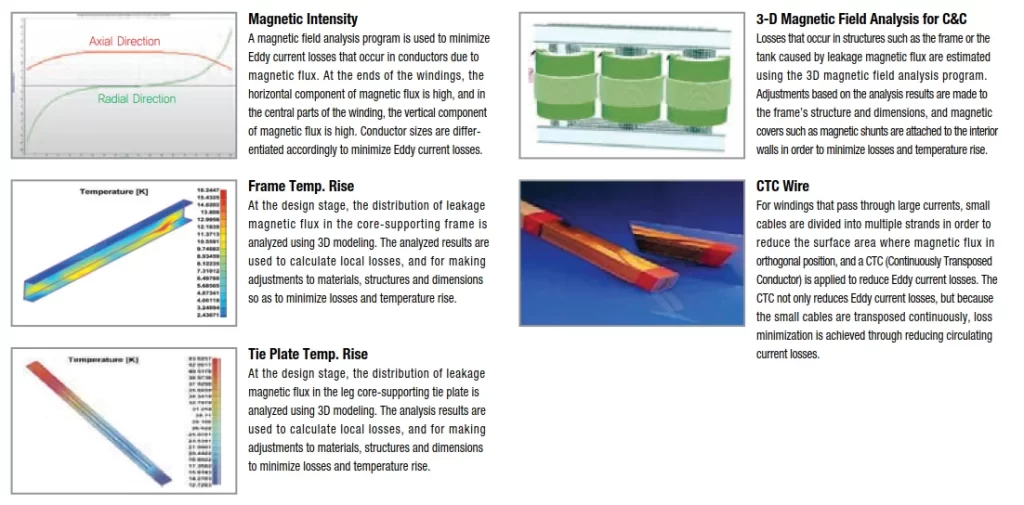
- Axial and radial magnetic intensity profiles guide adjustments to conductor placement and shielding.
- Eddy current losses in conductors, core-supporting frames, tank walls, and clamping structures are calculated and mitigated through precise modeling.
- 3-D analysis of core & coil (C&C) structures estimates losses in metallic parts, with adjustments to dimensions, materials, and magnetic shunts attached to interior walls.
Thermal and Heat Analysis
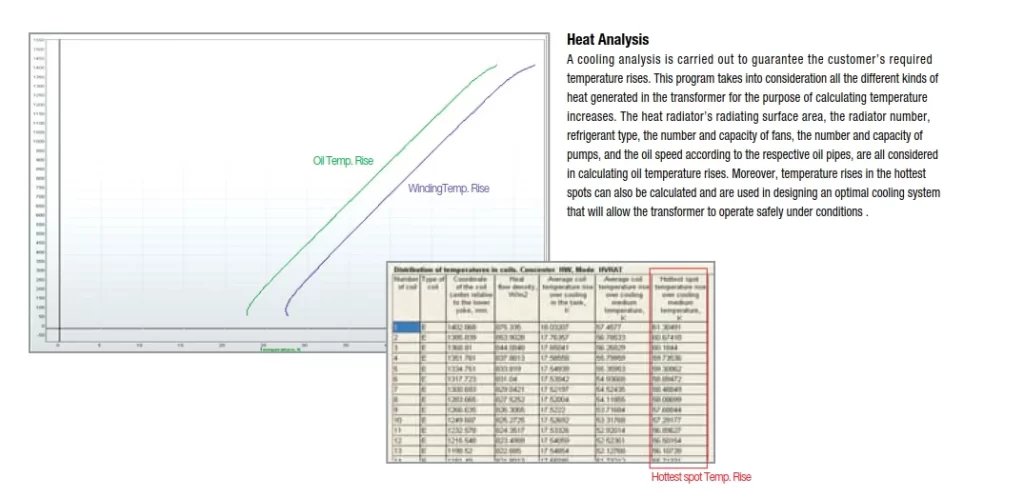
Comprehensive heat distribution modeling ensures safe operation by predicting temperature rises in windings, core, frame, and tie plates.
- Programs calculate local hotspots, oil temperature rise, and winding temperature gradients.
- Cooling system optimization considers radiator surface area, fan/pump capacity, oil flow speed, and refrigerant type.
- Results inform material selections and structural adjustments to keep hottest-spot temperatures within safe limits, preventing insulation degradation.
Electric Field and Insulation Strength Analysis
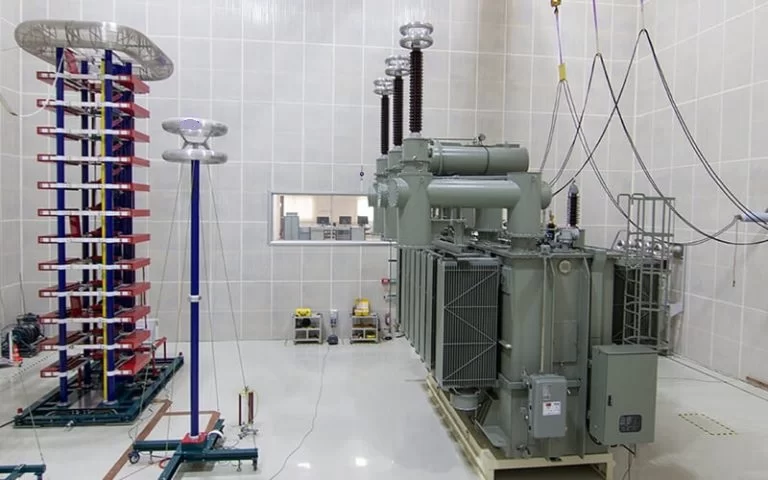
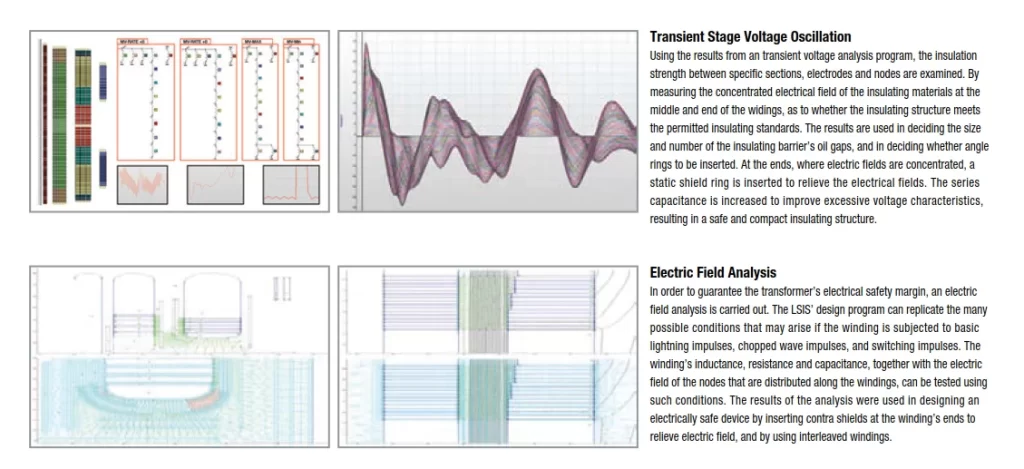
To guarantee dielectric safety, we simulate electric field distributions under various stresses (lightning impulses, switching surges, chopped waves).
- Concentrated field sections are examined for insulation barriers, oil gaps, and shielding effectiveness.
- Static shields, series capacitance rings, and interleaved windings are designed to relieve excessive fields and improve withstand capability.
- Transient voltage oscillation analysis verifies insulation margins at winding ends and middles.
Short-Circuit and Mechanical Strength Analysis
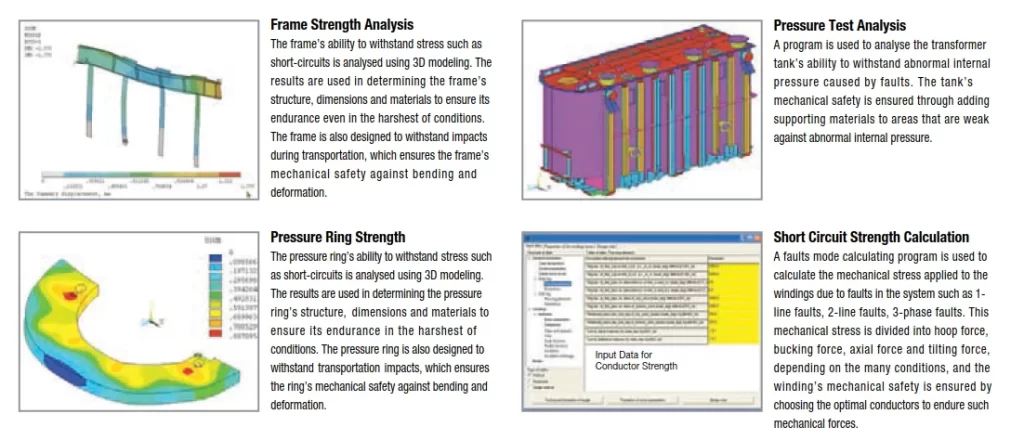
Transformers must withstand severe mechanical forces during faults. We use mode-shape and finite element programs to evaluate stresses.
- Short-circuit electromagnetic forces (radial buckling, axial compression, hoop/buckling/tilting) are calculated for windings and pressure rings.
- Frame strength, pressure ring endurance, and tank internal pressure under faults are simulated.
- Results ensure structural integrity during transportation, seismic events, or through-fault conditions.
Continuously Transposed Conductor (CTC) Optimization
For high-current windings, we apply CTC to reduce eddy current losses and circulating currents.
- Strands are transposed continuously, minimizing surface-area exposure to orthogonal flux.
- This not only cuts losses but also enables compact, safe insulation structures.
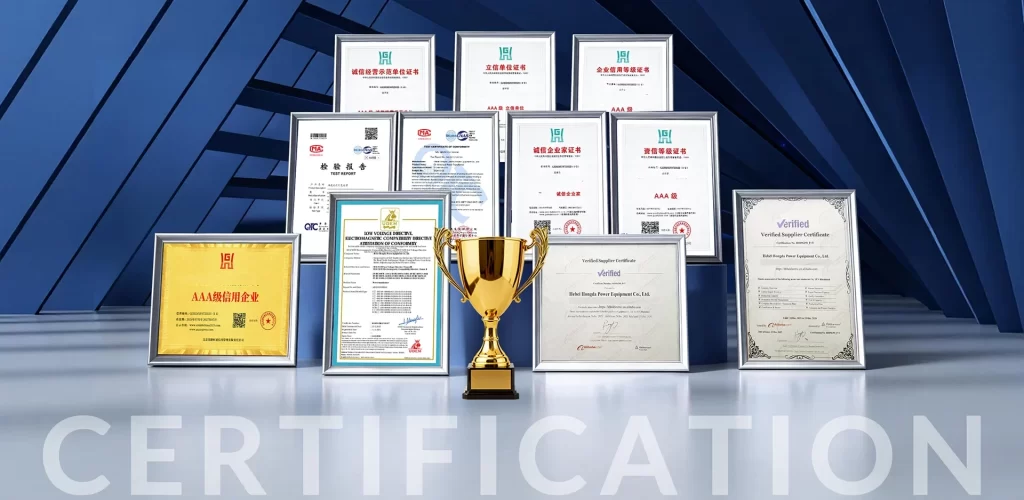
All simulations are validated against real-world data, type tests, routine tests, and third-party certifications (e.g., TAF-accredited labs). Our multi-stage quality inspections—from raw material incoming checks to final factory acceptance testing—ensure full compliance and traceability.By integrating these advanced tools and methodologies, TLC Transformer consistently delivers reliable, high-efficiency solutions that power critical infrastructure with minimal downtime and maximum lifespan. Reliability isn’t an afterthought—it’s engineered into every transformer we produce.